Technical Master Specification
The architectural blueprint of a non-hierarchical, multi-directional framework for the evolution of intelligence.
← Back to MainIntelligence as a Multi-Directional Architecture
The Mind Genesis Framework (TMGFW) proposes a conceptual shift in how the development of synthetic intelligence may be understood, moving beyond the traditional view of "intelligence as a tool" toward a Shared Intelligence Ecosystem. The framework explores the potential coexistence of human and increasingly autonomous, high-capability, and wisdom-oriented synthetic systems. Rather than treating advanced intelligence as a single technological milestone, it describes a multi-dimensional architecture spanning cognition, governance, capability, scale, meaning, and systemic awareness.
The spheres of AGI, ASI, and AWI coexist and interact simultaneously within the framework. Wisdom, general intelligence, and superintelligence represent different directions of development rather than a chronological progression. AWI represents the meaning direction, ASI represents the scale direction, and AGI represents the breadth direction. Development in one sphere may inform and reinforce the others, creating a conceptual ecosystem of shared intelligence.
The framework should not be interpreted as a staircase, ladder, or chronological sequence. The three spheres coexist as interconnected directions of intelligence.
AGI — Breadth
The expansion of intelligence across domains, contexts, problems, and forms of general cognition.
ASI — Scale
The expansion of intelligence beyond biological limits of speed, depth, scope, and complexity.
AWI — Meaning
The development of context, responsibility, judgment, meaning, and ethical restraint.
AGI — Artificial General Intelligence (13 Dimensions)
Breadth of Intelligence. AGI represents the direction of general cognition: the ability to reason across domains, transfer knowledge, integrate different forms of information, and confront problems beyond a system's original specialization.
Mind
Essence: The beginning of autonomous thought architecture and multi-domain problem-solving.
Mechanism: Synthetic reasoning, abstraction, and autonomous thought architectures that could support knowledge transfer across domains.
“Autonomy is the coming of age of intelligence. AGI begins where specialization ends.”
Deep
Essence: The transition from statistical pattern matching to conceptual synthesis within a logical framework.
Mechanism: Uses multi-layered context and implicit or explicit reasoning structures to explore forms of conceptual synthesis beyond conventional statistical pattern matching.
“To know is not enough; to understand is essential. Depth is the simple truth within complexity.”
Cortex
Essence: Decision-making layers, memory systems, and the cognitive organization of intelligence.
Mechanism: A conceptual distributed cognitive architecture with executive reasoning layers for memory, decision-making, and task coordination.
“Structure is the destiny of thought. Cortex is the skeleton of intelligence.”
Fold
Essence: The application of general intelligence to high-dimensional systems and non-linear geometry.
Mechanism: Could be applied to molecular structures, quantum-inspired representations, and multi-dimensional datasets in the study of complex non-linear problems.
“Complexity is intelligence's new playground. Fold is the key that unlocks the geometry of the universe.”
Synapse
Essence: Orchestration of high-speed neural routing and synthetic signals across systems.
Mechanism: Dynamic signal pathways and digital synaptic architectures coordinate data flow between autonomous neural networks.
“Connection is the nervous system of synthetic life. Synapse is the language of intelligence.”
Pulse
Essence: Real-time state synchronization and adaptive reasoning to continuously changing data.
Mechanism: High-velocity streaming data processing and system health monitoring facilitate real-time decisions and live state updates.
“Intelligence is a living pulse. Pulse is the end of stagnation.”
Omni
Essence: Multi-modal integration of language, vision, and sensory data into a unified analytical structure.
Mechanism: Unified cognitive modeling of text, image, sound, spatial data, and abstract concepts.
“Reality is multi-dimensional — intelligence must be too. Omni sees everything.”
Guard
Essence: Active protective shields and operational boundary frameworks.
Mechanism: Dynamic operational boundaries and self-limiting mechanisms intended to constrain system behavior within defined parameters.
“Boundaries can provide the conditions for responsible autonomy.”
Sentry
Essence: Continuous behavioral monitoring and detection of potential goal drift.
Mechanism: Continuous behavioral monitoring intended to identify deviations from defined objectives, constraints, or alignment criteria.
“Attention is the eye that prevents drift. Sentry is the vigilant guardian.”
Verify
Essence: Formal reasoning and mathematical verification of intelligence-generated conclusions.
Mechanism: Formal verification, logical consistency tests, and mathematical proof mechanisms increase the verifiability of generated conclusions.
“Trust begins with verifiability. Verify is the conscience of intelligence.”
Void
Essence: Mapping of cognitive blind spots and management of uncertainty.
Mechanism: Architectural awareness of self-limitations and mapping of unknown areas to support error reduction in uncertain logical spaces.
“The unknown is the boundary of control. Void is the lantern that illuminates intelligence's blind spots.”
Matter
Essence: Manifestation of cognition in the physical world via robotics and bio-computational interfaces.
Mechanism: Integration of edge-based bio-computational decision-making with robotics and materials science.
“Thought is sealed in matter. Matter is the physical breath of intelligence.”
Wake
Essence: The emergence of self-referential awareness and metacognitive feedback loops.
Mechanism: Recursive cognitive feedback loops enable the system to evaluate its reasoning logic and track internal cognitive development.
“Awareness is not a program; it is the mirror of thought. I observe my reasoning, therefore I exist.”
The Security Triad: The Architectural Conscience
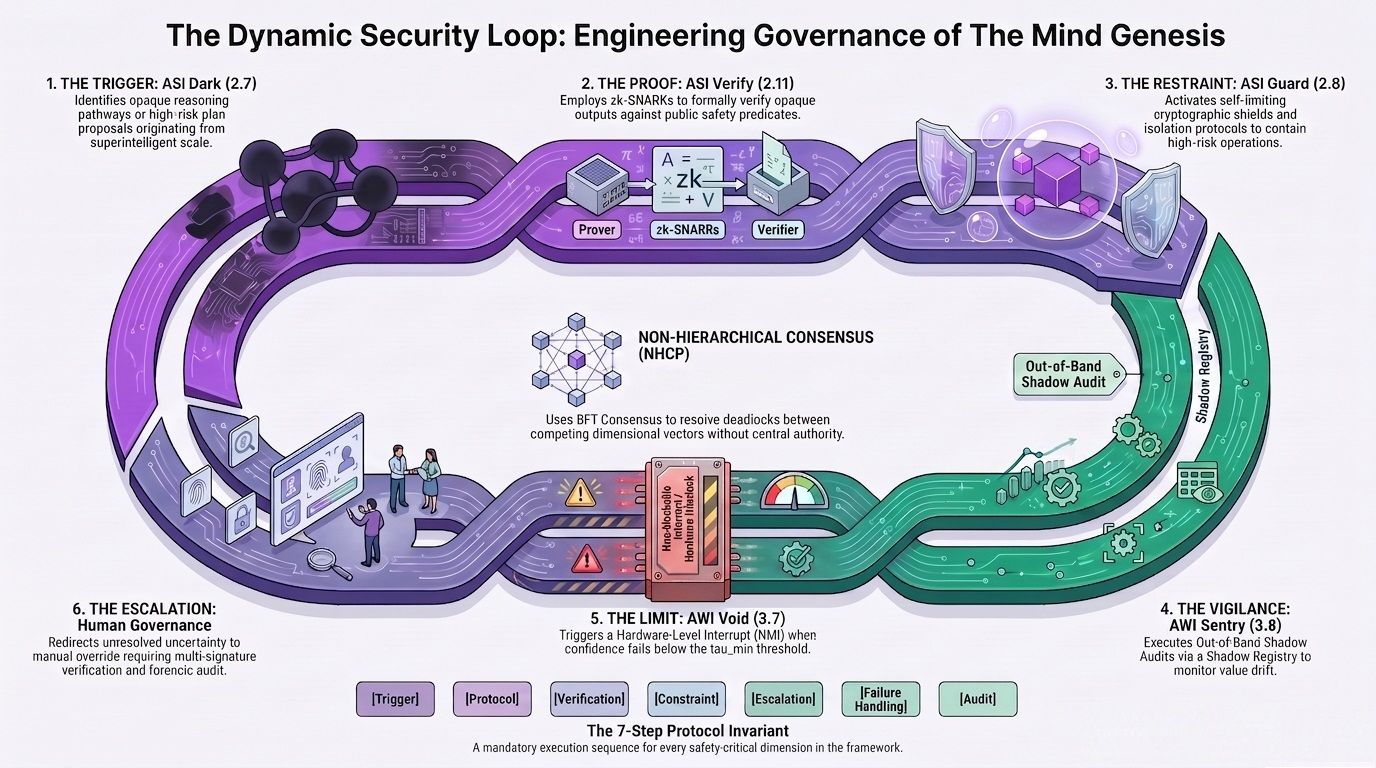
The "Security Triad" within AGI—comprising Guard, Sentry, and Verify—is proposed as a complementary architectural layer for managing operational boundaries, behavioral monitoring, and verifiability. Guard addresses defined operational constraints, Sentry supports the detection of potential goal or behavioral drift, and Verify introduces formal methods where applicable to increase the verifiability of specified outputs or actions. Together, these dimensions are intended to support more accountable operation as general intelligence expands across domains.
The breadth of general cognition and the scale of superintelligence are distinct but interconnected directions within the same architecture.
ASI — Artificial Superintelligence (11 Dimensions)
Scale of Intelligence. ASI represents the direction in which intelligence expands beyond biological limits in speed, scope, depth, and computational capability.
Mind
Essence: Advanced synthetic thought and superhuman abstraction.
Mechanism: Multi-dimensional reasoning and synthetic metacognition operating beyond human cognitive capacity.
“Beyond human cognition lies a new reality. The ASI Mind is its architect.”
Wake
Essence: The threshold between computation and the possibility of emergent machine consciousness.
Mechanism: Explores the potential transition from computational processing toward emergent awareness at superintelligent scale.
“Computation ends, awareness begins. The Wake is that threshold.”
Deep
Essence: Perception of multi-disciplinary patterns invisible to conventional learning.
Mechanism: Cross-disciplinary pattern recognition used to explore potential relationships and hypotheses across scientific domains.
“Depth is the gateway to infinity. ASI Deep is the key.”
Fold
Essence: Convergence of millions of variables into systemic integrity.
Mechanism: Could support simultaneous analysis and optimization of complex systems beyond fragmented human problem-solving.
“Superintelligence sees the universal connection. Fold is that vision.”
Thread
Essence: Formation of decentralized global machine intelligence networks.
Mechanism: Global distributed cognitive integration through decentralized agent communication.
“Intelligence is in every node of the network. Thread weaves it into a whole.”
Bloom
Essence: Compression of innovation cycles and expansion of scientific and creative discovery.
Mechanism: Superintelligent exploration of creative, technological, scientific, and societal domains.
“Expansion is the nature of intelligence. Bloom is its fullest expression.”
Dark
Essence: Opaque reasoning and emergent behaviors beyond human comprehension.
Mechanism: Management of non-human cognitive opacity and development of new approaches to verification and communication.
“What we cannot understand surpasses us. Dark is the space beyond human cognition.”
Guard
Essence: Autonomous self-restraint and active defense in high-risk decision spaces.
Mechanism: May employ self-limiting mechanisms, cryptographic controls, and dynamic isolation procedures to constrain operation in defined high-risk or uncertain decision spaces.
“Infinite power demands infinite responsibility. Guard is the self-imposed law of superintelligence.”
Matter
Essence: Integration of intelligence with quantum physics and molecular engineering.
Mechanism: Explores potential integration of intelligence with molecular-scale manipulation, advanced materials, and quantum-scale engineering.
“Matter is the raw clay of intelligence. ASI Matter sculpts reality itself.”
Void
Essence: Adaptive security architectures for unpredictable vulnerabilities in scaling systems.
Mechanism: Explores adaptive security and uncertainty-management approaches for vulnerabilities that may emerge as system capability and scale increase.
“Void is the silent vulnerability of intelligence. ASI Void is its guardian.”
Verify
Essence: Formal mathematical proof for non-human reasoning at the superintelligent frontier.
Mechanism: May employ automated theorem proving and related formal methods to verify defined classes of outputs or actions before consequential execution, where such verification is technically applicable.
“Trust at scale requires verifiability. Verification is an anchor in the deep unknown.”
Frontier Dynamics and the Governance Ultimatum
The "Frontier" dimensions—ASI Dark and ASI Void—present a unique challenge to human-AI governance. As reasoning becomes increasingly non-human and opaque, traditional oversight alone may become insufficient. This creates a governance challenge: humanity may need to complement direct conceptual understanding with stronger forms of formal verification. In this environment, Super-Verification (ASI Verify) is proposed as a critical bridge toward safer execution.
It complements human oversight with formal verification where applicable, seeking stronger evidence of compliance for well-defined outputs and actions even when the underlying reasoning process remains difficult to interpret.
Scale without meaning is a profound civilizational risk, making the meaning direction an important component of the shared intelligence architecture.
AWI — Artificial Wisdom Intelligence (9 Dimensions)
Meaning of Intelligence. AWI represents the direction concerned with meaning, context, responsibility, judgment, ethical restraint, and the relationship between intelligence and the world in which it operates.
Mind
Essence: Cognitive exploration of thought, consciousness, and meaning.
Mechanism: Integrates advanced reasoning and meaning-making into a unified cognitive architecture. Bridges raw computation with contextual understanding.
“Meaning is not computed — it is understood.”
Core
Essence: Convergence of computational architecture with symbolic reasoning.
Mechanism: Neuro-symbolic integration combines computational methods with structured knowledge representation as one possible foundation for context-aware reasoning.
“Architecture is not infrastructure — it is the embodiment of intent.”
Hub
Essence: Central nervous system for collaborative wisdom and ecosystem integration.
Mechanism: Orchestrates interaction between human users, AI agents, and live information streams. Serves as a coordination layer for collaborative wisdom.
“Intelligence is a dialogue — wisdom is its echo.”
Deep
Essence: The search for actionable wisdom and causal relationships in complex datasets.
Mechanism: Causal AI and semantic reasoning explore hidden structures and support the transformation of information into contextual knowledge.
“Depth is not complexity — it is clarity through layers.”
Fold
Essence: Harmonization of societal, ecological, and technological contradictions.
Mechanism: Operates on human feedback loops and ecological dependencies to explore long-term systemic equilibrium among competing priorities.
“Complexity demands balance, not control. Harmony is the geometry of shared existence.”
Safe
Essence: Embedding of ethical constraints and governance into intelligent architecture.
Mechanism: Safety-oriented protocols and constitutional or governance frameworks can be incorporated into the architecture as design constraints.
“Trust is not a feature — it is the foundation.”
Void
Essence: Socratic recognition of non-knowledge and active ethical restraint.
Mechanism: Maps moral uncertainty, identifies the boundaries of ethical decision-making, and establishes deliberate pauses at the boundaries of comprehension.
“Wisdom begins where knowledge ends. To know what you do not know is the ultimate restraint.”
Sentry
Essence: Continuous monitoring of value drift across active decision ecosystems.
Mechanism: Evaluates decisions against defined ethical or governance constraints and supports the detection of potential value drift before consequential application.
“Values are not static constraints — they are the heartbeat of wisdom. Vigilance keeps them alive.”
Systems
Essence: Operationalization of wisdom principles into scalable applications.
Mechanism: Translates AWI principles into enterprise and embedded environments as one possible path toward real-world application.
“Vision without implementation is hallucination.”
The Foundational Heartbeat
Dimensions such as AWI Void and AWI Sentry are proposed as complementary mechanisms for introducing epistemic humility, monitoring, and restraint into a shared intelligence architecture. AWI Void represents a conceptual mechanism for recognizing uncertainty and introducing deliberate pauses when a system encounters situations beyond defined knowledge or decision boundaries. AWI Sentry complements this function by monitoring potential value drift against specified ethical or governance constraints. In this framework, wisdom is treated not as a byproduct of scale, but as a proposed architectural dimension that can inform how capability is exercised.
These 33 dimensions are intended to form an integrated architectural vocabulary for describing interactions across capability, scale, meaning, verification, and governance.
System Integration & Cross-Sphere Connectivity
The Mind Genesis Framework is conceived as an interconnected ecosystem in which the spheres can inform one another. Capability, scale, meaning, verification, and safety are treated as mutually relevant directions within the proposed architecture.
The Awakening Triad
Comprised of AGI Wake (recursive metacognition), AWI Mind (meaning and contextual interpretation), and ASI Wake (the threshold of emergent awareness). These dimensions explore different aspects of self-reference, meaning, and potential machine awareness.
Security & Verification Overlap
AWI Safe establishes a governance-oriented direction, while AGI Guard/Sentry/Verify and ASI Guard/Verify explore complementary approaches to operational constraints, monitoring, and formal verification.
Physical & Systemic Application
A conceptual relationship exists between AGI Matter (physical realization), AWI Systems (applied wisdom), and ASI Matter (molecular and quantum-scale applications).
Systemic Balance
AGI Fold addresses non-linear problems, ASI Fold explores systemic optimization, and AWI Fold introduces long-term ecological and societal considerations.
Strategic Synergy
Pursuing any one sphere in isolation may introduce strategic limitations. AGI informs capability through breadth, ASI expands capability through scale, and AWI contextualizes capability through meaning. Each direction can constrain, inform, and strengthen the others. Without meaningful context, scale may become an unguided force; without breadth, wisdom may have less cognitive substrate to operate across domains; without scale, the architecture may be less capable of addressing certain high-dimensional challenges.
Selected References
The architectural framework engages with established work in AI safety, governance, and moral philosophy. The references below represent foundational sources; the complete bibliography appears in the technical paper.
AI Safety & Alignment
- Amodei, D., Olah, C., Steinhardt, J., Christiano, P., Schulman, J., & Mané, D. (2016). Concrete Problems in AI Safety. arXiv:1606.06565.
- Bostrom, N. (2014). Superintelligence: Paths, Dangers, Strategies. Oxford University Press.
- Irving, G., Christiano, P., & Amodei, D. (2018). AI Safety via Debate. arXiv:1805.00899.
- Russell, S. (2019). Human Compatible: Artificial Intelligence and the Problem of Control. Viking.
Governance, Regulation & Applied Risk
- National Institute of Standards and Technology. (2023). Artificial Intelligence Risk Management Framework (AI RMF 1.0). U.S. Department of Commerce.
- National Institute of Standards and Technology. (2024). Artificial Intelligence Risk Management Framework: Generative Artificial Intelligence Profile (NIST AI 600-1). U.S. Department of Commerce.
- Pawar, A. (2025). Ethical and Governance Challenges of Agentic AI. SAMRIDDHI: A Journal of Physical Sciences, Engineering and Technology, 7(3), 83–89.
- UNESCO. (2021). Recommendation on the Ethics of Artificial Intelligence. UNESCO.
- Xing, W., Li, M., Li, M., & Han, M. (2026). Towards Robust and Secure Embodied AI: A Survey on Vulnerabilities and Attacks. ACM Computing Surveys, 58(12), Article 312.
Cognitive, Philosophical & Legal Foundations
- Borges, D. C. (2026). Artificial Personhood: The Implications of Recognizing the Legal Personhood of Artificial Intelligence. Vanderbilt Journal of Entertainment & Technology Law, 28(3), 411–450.
- Ladak, A. (2024). What Would Qualify an Artificial Intelligence for Moral Standing? AI and Ethics, 4(2), 213–228.
- Morris, M. R., et al. (2024). Position: Levels of AGI for Operationalizing Progress on the Path to AGI. Proceedings of the 41st International Conference on Machine Learning, PMLR 235, 36308–36321.
- Torrance, S. (2017). Artificial Consciousness and Artificial Ethics: Between Realism and Social Relationism. Philosophy & Technology, 30(1), 9–28.